package main

import "fmt"

type Server struct {
	maxConn		int
	tls			bool
	id			string

}

func newServer(maxConn int, tls bool, id string) *Server {
	return &Server{
		maxConn:	maxConn,
		tls:		tls,
		id:			id,
	}
}

func main() {
	s := newServer(100, false, "server1")
	fmt.Println(s)
}
Here is a function that starts a server.
When calling newServer(), you must pass arguments such as maxConn, tls, and id.
There are only three for now, so it is hard to forget them, but with 10 or 20 arguments you may start forgetting some and the program will fail to run.
Opts struct
Let’s move the properties from the existing Server struct into a struct called Opts, and let Server contain an Opts struct.
package main

import "fmt"


type Opts struct {
	maxConn		int
	tls			bool
	id			string
}

type Server struct {
	opts	Opts
}


func newServer(opts Opts) *Server {
	return &Server{
		opts:	opts,
	}
}

func main() {
	o := Opts {
		maxConn:	100,
		tls:		true,
		id:			"server1",
	}
	s := newServer(o)
	fmt.Println(s)
}
The code now passes a single Opts struct instead of three arguments, but we still need to initialize the values of all three properties.
Now let’s apply the Functional Options pattern.
defaultOpts
package main

import "fmt"


type OptsFunc func(*Opts)

type Opts struct {
	maxConn		int
	tls			bool
	id			string
}

type Server struct {
	opts	Opts
}

func defaultOpts() Opts {
	return Opts {
		maxConn:	100,
		tls:		false,
		id:			"default-server",
	}
}


func newServer(optsFunc ...OptsFunc) *Server {
	o := defaultOpts()

	for _, fn := range optsFunc {
		fn(&o)
	}

	return &Server {
		opts:	o,
	}
}

func main() {
	s := newServer()
	fmt.Printf("%+v", s)
}
OptsFunc type: a function signature that takes *Opts as an argument
defaultOpts(): initializes and returns the default values for Opts
newServer(): accepts multiple OptsFunc values and initializes defaults using defaultOpts() (if no OptsFunc is passed, the defaults are used). If any OptsFunc values are provided, it applies them in a loop to initialize the options, then returns the result.
The loop iterates once for each OptsFunc passed as an argument. fn is a function that takes *Opts, so we can initialize values using the supplied OptsFunc by calling fn(&o).
Although main() currently passes no values to newServer(), running it as-is gives us:
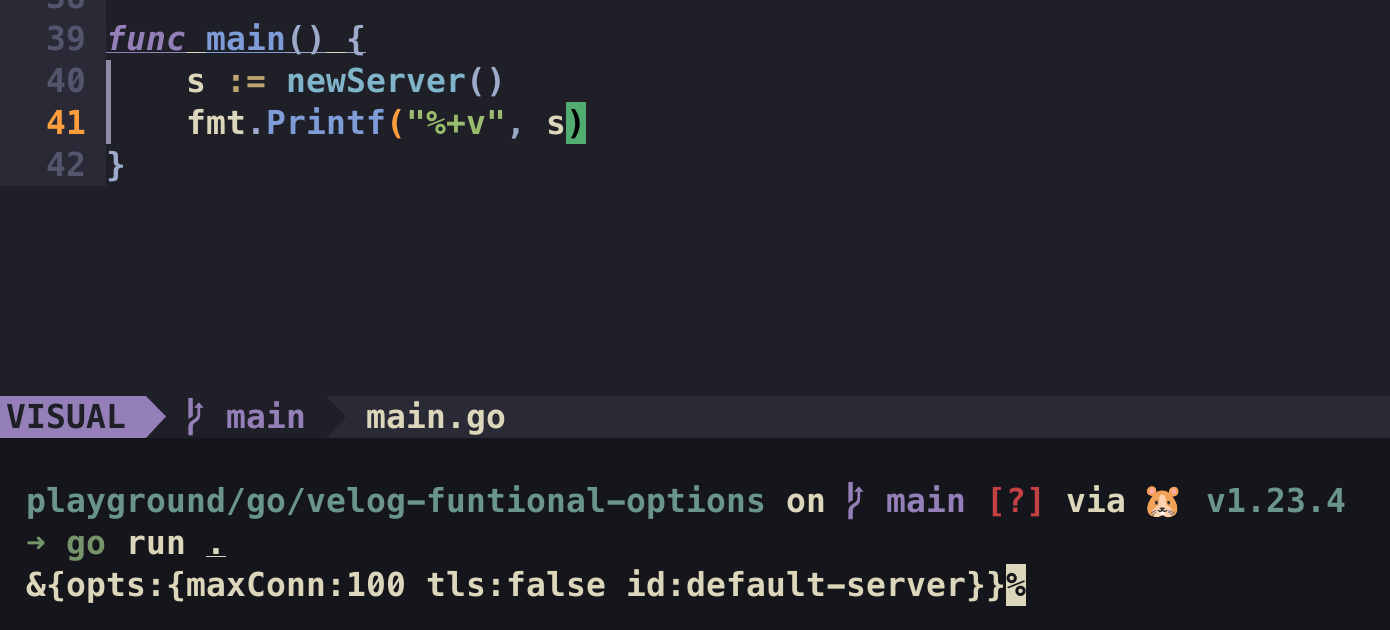
The default values initialized in defaultOpts() are set.
Now let’s create configuration functions so that users can pass custom values.
User configuration functions
func withTLS(opts *Opts) {
	opts.tls = true
}

func withMaxConn(conn int) OptsFunc {
	return func(opts *Opts) {
		opts.maxConn = conn
	}
}

func withID(id string) OptsFunc {
	return func(opts *Opts) {
		opts.id = id
	}
}
withTLS(): Since tls is a boolean and can only be true or false, it takes no value; using the function sets it to true. (If not used, the false initialized by defaultOpts() is used.) Since its signature matches OptsFunc, it can be passed to newServer() in main() as withTLS, without calling it like withTLS(Opts{}).
withMaxConn(): Takes a user-configured connection count and returns an OptsFunc.
withID(): Takes a user-configured ID and returns an OptsFunc.
They all return OptsFunc because newServer() takes arguments of that type. withTLS takes no user-provided value and its signature already matches OptsFunc, so it can be passed directly to newServer().
Results
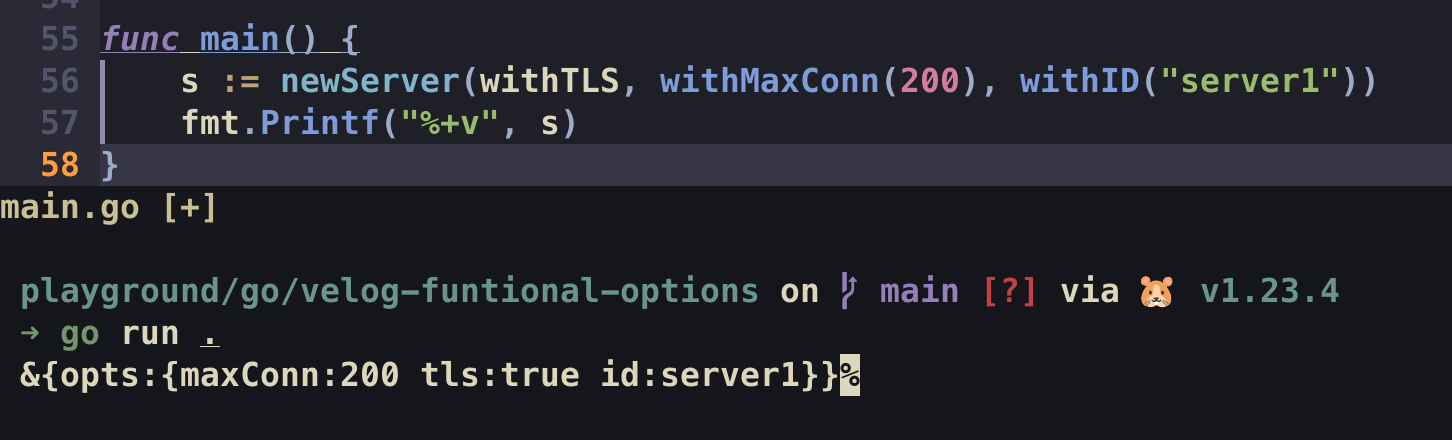
withTLS, withMaxconn(200), withID("server1")
withMaxConn(50)
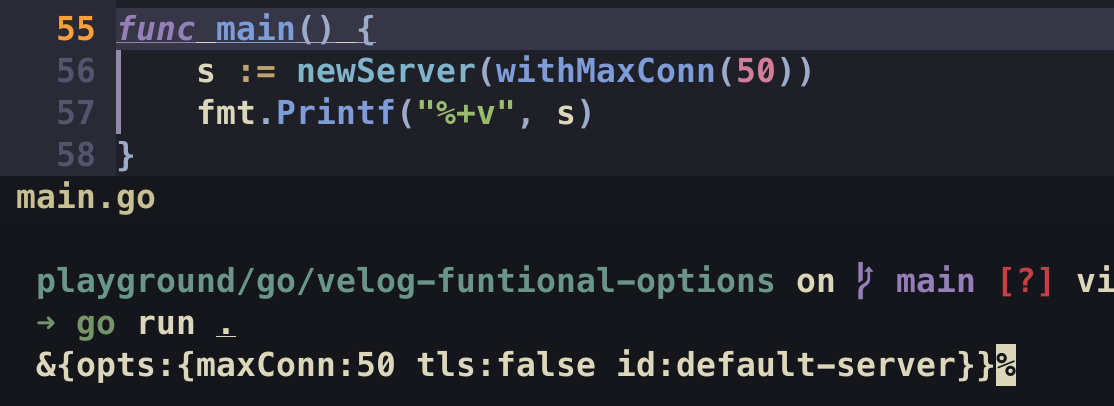
This demonstrates the Functional Options pattern: when no OptsFunc is provided, defaults are used; when one is provided, only the corresponding values are set to the supplied values.
I’ve used options like these when initializing instances with S3 APIs, Gorm, and similar tools. Trying the pattern out helped me understand its benefits. It seems especially useful when building libraries in Go.
Thank you for reading!
>> Home