I often use Github Actions as my CI tool.
As you all know, Github Actions workflows are written in YAML, and many of us have probably received a CI job failed notification because of indentation or incorrect syntax.
Then I came across this post on Twitter:
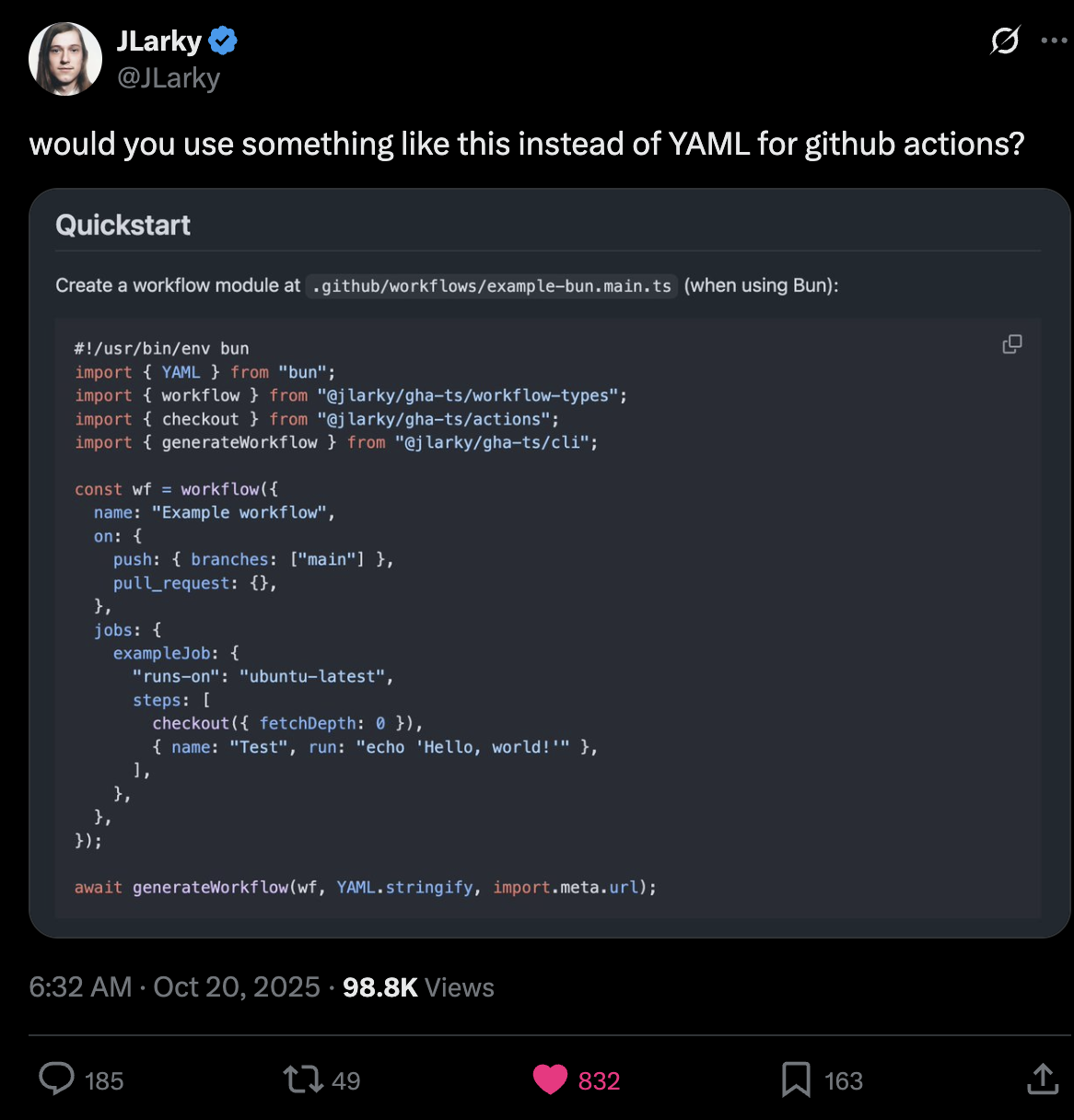 This
gha-ts project is open source software that generates a .yml file when you write a workflow in TypeScript.
It lets you generate type-safe workflows without worrying about indentation or syntax.
I noticed that setup already supported node, java, python, go, and dotnet, but not bun, so I decided to add bun setup.
Code
First, I cloned the repository and created a branch.
All the setup functions and interfaces are declared in the /src/actions/setup.ts file, so I wrote the code there.
Existing code
import { uses, UsesStep } from "../workflow-types";
import { buildWith, CamelToKebabMap } from "./common";

export interface SetupNodeOptions {
  nodeVersion?: string; // node-version
  cache?: "npm" | "pnpm" | "yarn";
  cacheDependencyPath?: string; // cache-dependency-path
  registryUrl?: string; // registry-url
  scope?: string; // scope
  alwaysAuth?: boolean | string; // always-auth
  nodeVersionFile?: string; // node-version-file
  architecture?: string; // architecture
  checkLatest?: boolean | string; // check-latest
  token?: string; // token
  mirror?: string; // mirror
  mirrorToken?: string; // mirror-token
}
const setupNodeMap: CamelToKebabMap = {
  nodeVersion: "node-version",
  nodeVersionFile: "node-version-file",
  cacheDependencyPath: "cache-dependency-path",
  registryUrl: "registry-url",
  alwaysAuth: "always-auth",
  checkLatest: "check-latest",
  mirrorToken: "mirror-token",
};
export function setupNode(options: SetupNodeOptions = {}): UsesStep {
  return uses("actions/setup-node@v4", buildWith(options, setupNodeMap));
}
/* ... omitted for brevity ... */
export interface SetupDotnetOptions {
  dotnetVersion?: string; // dotnet-version
  dotnetQuality?: string; // dotnet-quality
  globalJsonFile?: string; // global-json-file
  sourceUrl?: string; // source-url
  owner?: string; // owner
  configFile?: string; // config-file
  cache?: boolean | string; // cache
  cacheDependencyPath?: string; // cache-dependency-path
}
const setupDotnetMap: CamelToKebabMap = {
  dotnetVersion: "dotnet-version",
  dotnetQuality: "dotnet-quality",
  globalJsonFile: "global-json-file",
  sourceUrl: "source-url",
  configFile: "config-file",
  cacheDependencyPath: "cache-dependency-path",
};
export function setupDotnet(opts: SetupDotnetOptions = {}): UsesStep {
  return uses("actions/setup-dotnet@v4", buildWith(opts, setupDotnetMap));
}
The code is simple. All I needed was an interface defining the options (version, etc.) passed to set-up, a Map mapping those options to kebab-case, and a setup function that uses them to return the result.
(As of October 22, 2025, CamelToKebabMap has been removed.)
I wrote the code as follows.
Code I added
export interface SetupBunOptions {
  bunVersion?: string; // bun-version
  bunVersionFile?: string; // bun-version-file
  bunDownloadUrl?: string; // bun-download-url
  registryUrl?: string; // registry-url
  scope?: string; // scope
}
const setupBunMap: CamelToKebabMap = {
  bunVersion: "bun-version",
  bunVersionFile: "bun-version-file",
  bunDownloadUrl: "bun-download-url",
  registryUrl: "registry-url",
  scope: "scope",
};
export function setupBun(opts: SetupBunOptions = {}): UsesStep {
  return uses("oven-sh/setup-bun@v2", buildWith(opts, setupBunMap));
}
I took SetupBunOptions from the bun GitHub repository.
Writing tests
To check that it works correctly, I wrote a test file under /tests/.
import { describe, it, expect } from "bun:test";
import { setupBun } from "../src/actions/setup";
import { createSerializer } from "../src/render";
import { Workflow } from "../src/workflow-types";

const renderWorkflow = (workflow: Workflow) => {
  return createSerializer(workflow, Bun.YAML.stringify).stringifyWorkflow();
};

describe("setupBun", () => {
  it("should render with default options", () => {
    const workflow: Workflow = {
      name: "Test Workflow",
      on: "push",
      jobs: {
        test: {
          "runs-on": "ubuntu-latest",
          steps: [setupBun()],
        },
      },
    };
    expect(renderWorkflow(workflow)).toMatchInlineSnapshot(`
      "# Do not modify!
      # This file was generated by https://github.com/JLarky/gha-ts

      name: Test Workflow
      "on": push
      jobs:
        test:
          runs-on: ubuntu-latest
          steps:
            - uses: oven-sh/setup-bun@v2
      "
    `);
  });

  it("should render with a specific bun version", () => {
    const workflow: Workflow = {
      name: "Test Workflow",
      on: "push",
      jobs: {
        test: {
          "runs-on": "ubuntu-latest",
          steps: [setupBun({ bunVersion: "1.0.0" })],
        },
      },
    };
    expect(renderWorkflow(workflow)).toMatchInlineSnapshot(`
      "# Do not modify!
      # This file was generated by https://github.com/JLarky/gha-ts

      name: Test Workflow
      "on": push
      jobs:
        test:
          runs-on: ubuntu-latest
          steps:
            - uses: oven-sh/setup-bun@v2
              with:
                bun-version: 1.0.0
      "
    `);
  });

  it("should render with all options", () => {
    const workflow: Workflow = {
      name: "Test Workflow",
      on: "push",
      jobs: {
        test: {
          "runs-on": "ubuntu-latest",
          steps: [
            setupBun({
              bunVersion: "latest",
              bunVersionFile: ".bun-version",
              bunDownloadUrl: "https://example.com/bun.zip",
              registryUrl: "https://registry.npmjs.org",
              scope: "@my-scope",
            }),
          ],
        },
      },
    };
    expect(renderWorkflow(workflow)).toMatchInlineSnapshot(`
      "# Do not modify!
      # This file was generated by https://github.com/JLarky/gha-ts

      name: Test Workflow
      "on": push
      jobs:
        test:
          runs-on: ubuntu-latest
          steps:
            - uses: oven-sh/setup-bun@v2
              with:
                bun-version: latest
                bun-version-file: .bun-version
                bun-download-url: https://example.com/bun.zip
                registry-url: https://registry.npmjs.org
                scope: "@my-scope"
      "
    `);
  });
});
The result is  The tests pass as expected.
Testing
Now I’ll actually create a workflow in TypeScript and check whether it generates the yml correctly.
.github/workflows/setup-bun.ts
#!/usr/bin/env bun
import { YAML } from "bun";
import { workflow } from "../../src/workflow-types";
import { checkout, setupBun } from "../../src/actions";
import { generateWorkflow } from "../../src/cli";

const wf = workflow({
  name: "Example workflow",
  on: {
    push: { branches: ["main"] },
    pull_request: {},
  },
  jobs: {
    exampleJobBun: {
      "runs-on": "ubuntu-latest",
      steps: [
        checkout({ fetchDepth: 0 }),
        setupBun({ bunVersion: "1.3.0" }),
        { name: "Test", run: "bun --version" },
      ],
    },
  },
});

await generateWorkflow(wf, YAML.stringify, import.meta.url);
Grant this file execute permission and run it.
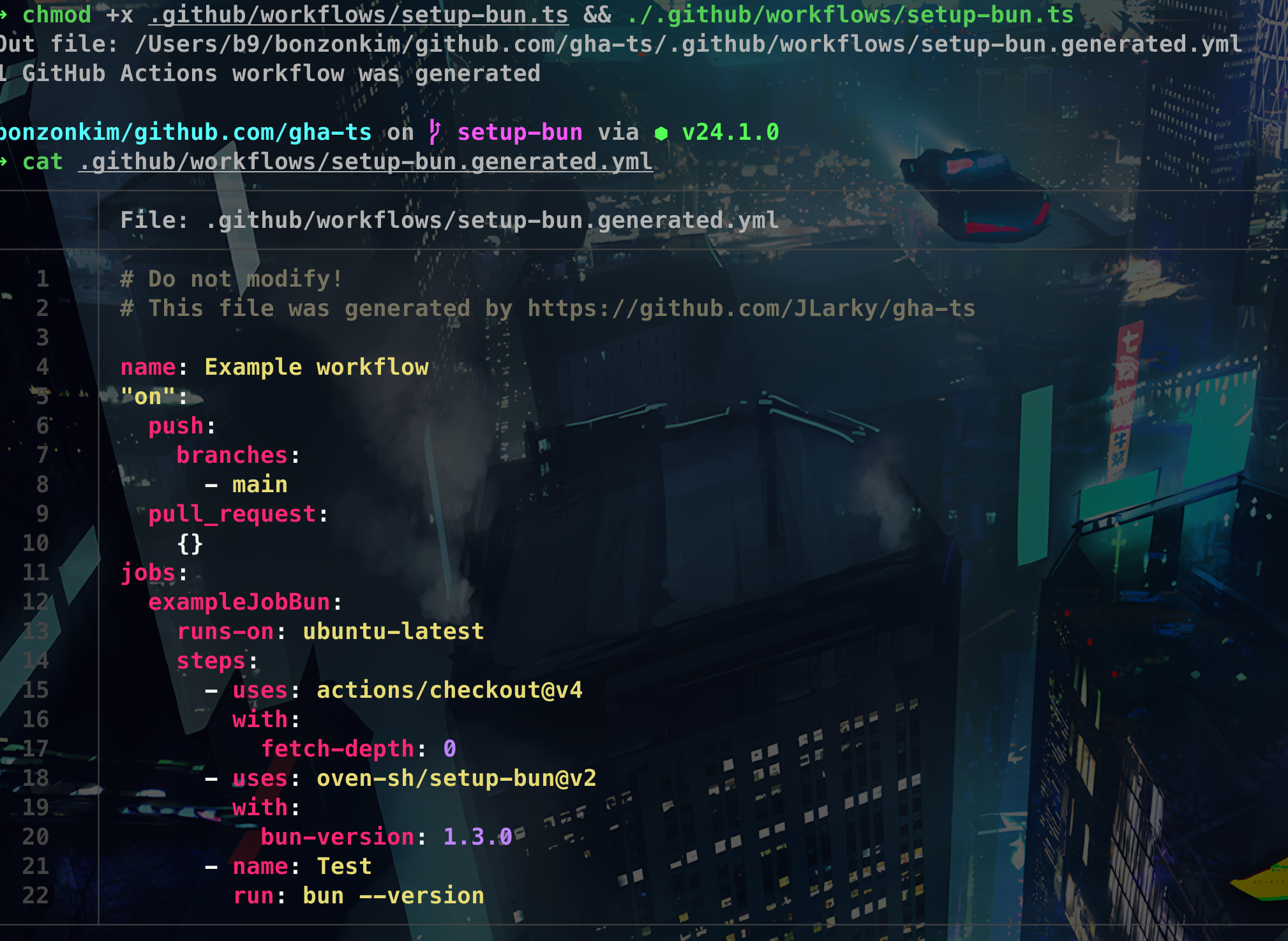 Now that I’ve confirmed it works correctly, I’ll commit and submit a PR!
Result
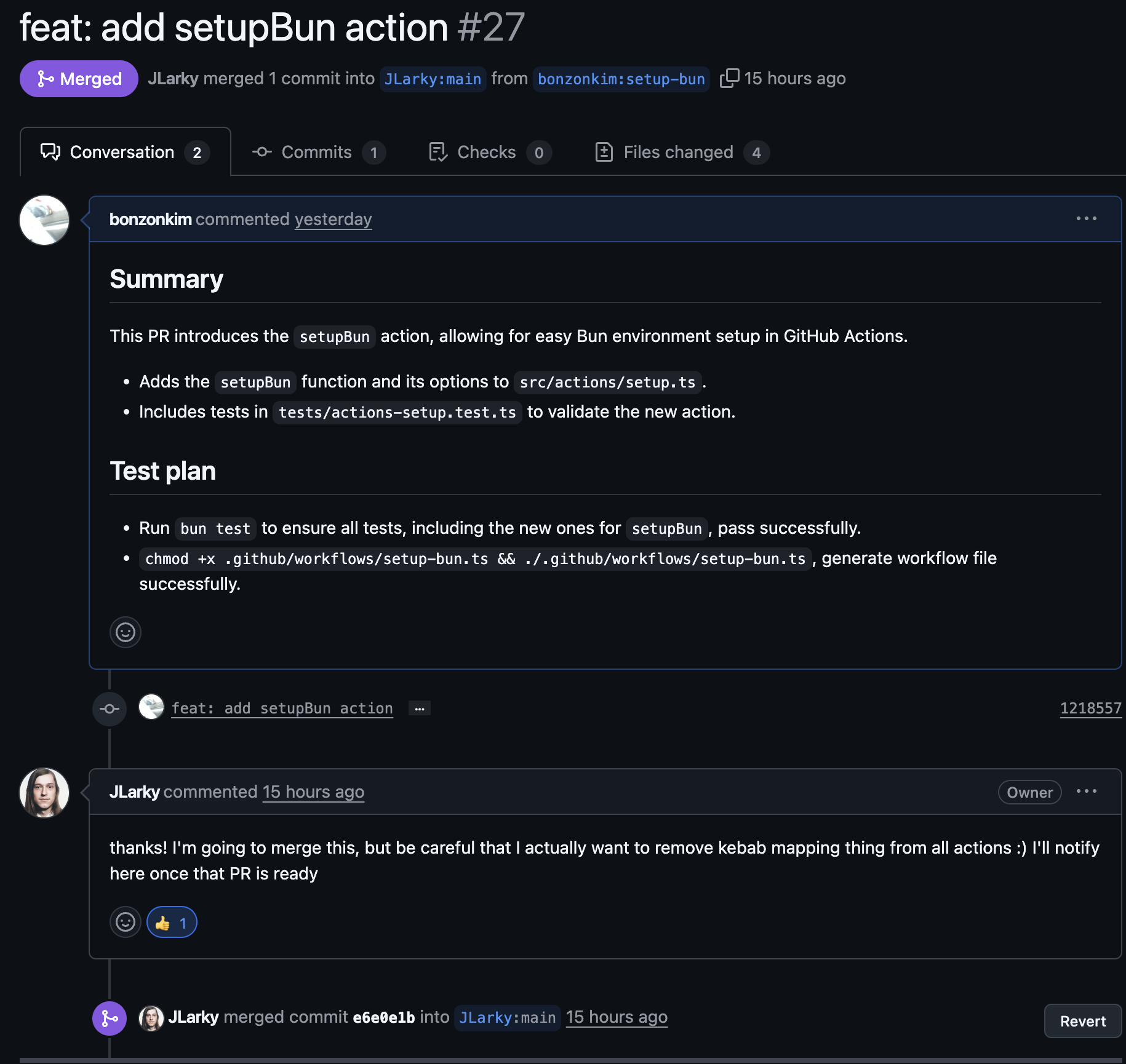 It was merged!
I’ve always wanted to become an open-source contributor, but I never got around to contributing to large projects like Kubernetes or Grafana because they felt daunting.
This time, I had a great experience contributing to a project with more than 100 stars.